The mind map, check-ins & profile
The engine room of Psyche: how a morning check-in, a game, or a reading becomes a domain score, and how the map, the lenses, and the profile present those scores without ever overstating them. This is the page for understanding what the numbers are, where they come from, and why some bars are faded.
Check-ins: the daily grain
The Morning Check-In opens the home most days: an energy slider from Exhausted to Energetic, a grid of eight emotions — joy, trust, fear, surprise, sadness, disgust, anger, anticipation — and Today's Intention, a free-text sentence about what you want the day to be. The evening check-in mirrors it for reflection. Saving takes under a minute, and a check-in is never scored as good or bad — it is a sample of you on a day, which is the only kind of sample a map like this can honestly use.
Check-ins compound. The calendar heatmap and the streak counter reward returning, the mood pattern across weeks becomes visible, and every saved check-in is evidence the map uses to form and refine domains. A skipped week is not a failure — the confidence legend simply shows what a gap does to the estimates: they age.
The mind map
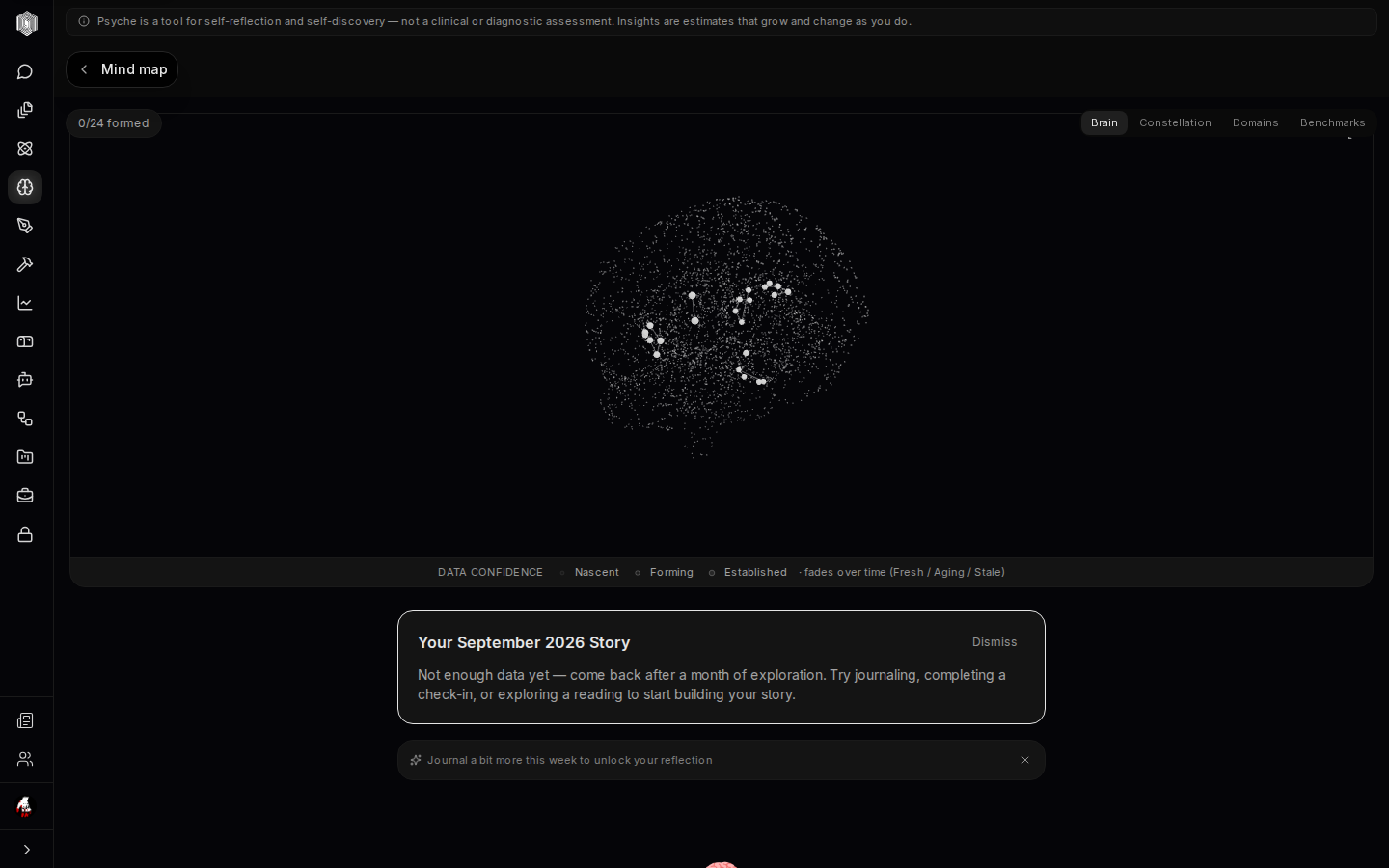
The Mind Map pillar opens the observatory full-bleed: a brain of thousands of points, with the formed regions lit. The counter in the corner — 0/24 formed on a fresh account — is the map's own honesty: a domain becomes "formed" when enough activity has touched it, and the data-confidence legend (Nascent, Forming, Established) explains that confidence fades over time as data ages, fresh or stale. The map is not a portrait; it is a live estimate with its sleeves visible.
Four lenses read the same data differently. Brain is the anatomical view — scores mapped onto regions of the brain. Constellation draws the domains as stars with connections, the view for seeing which domains rise together. Domains is the ranked list, plain numbers with their confidence. Benchmarks compares your estimates against the community distribution — always as range and context, never as a leaderboard. Clicking any domain opens its detail: the score, its trend, which activities contributed to it, and what would deepen it.
The twenty-four domains
The domains cover character broadly rather than clinically: Personality, Emotionality, Behavioral, Persona, Shadow, Morality, Gender, Psychosexual, Attachment, Parental, Cognition, Creativity, Existential, Spirituality, Interpersonal, Somatic, Resilience, Intuition, Identity, Motivation, Communication, Learning, Cultural, and Desire. Different activities feed different subsets — a Rorschach game moves Shadow and Identity; a Big Five test moves Personality; readings and Therapy-tab conversations are logged, but the conversation itself does not move a domain score, while a session's mood check-in (when your mood rises) and exercises or tools you complete do — which is why the profile's domain list is the honest summary of what you have actually explored.
The list is ranked by score, and the faded, dashed bars are part of the data: a domain that has not been touched enough to trust yet is drawn as untrusted rather than given a confident number. The note above the bars says exactly that. Where another product would print a score, Psyche prints an estimate and its confidence — or an honest dash.
The profile
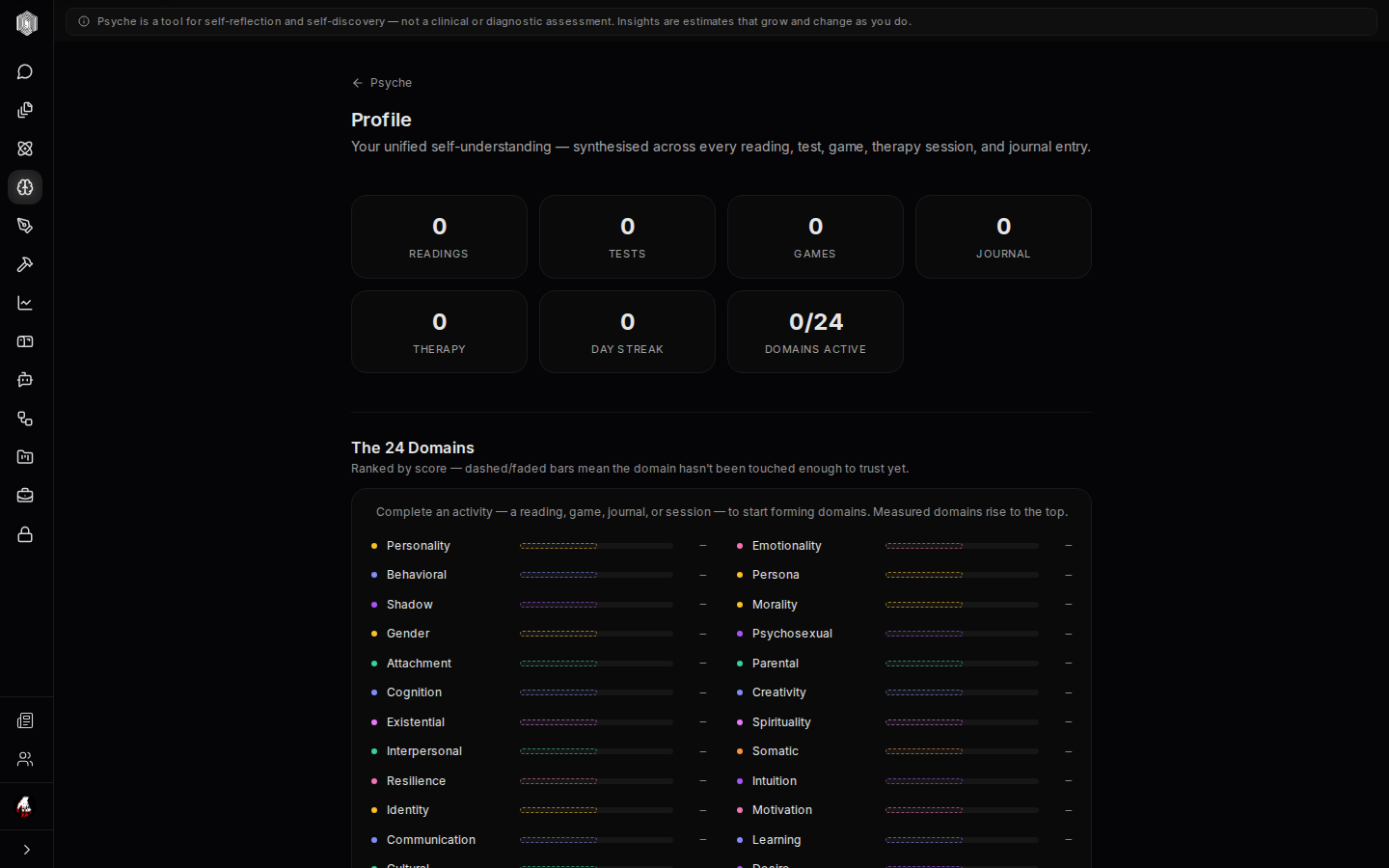
The profile is the synthesis page: a summary drawn from your readings, tests, games, Therapy-tab conversations and journal entries. The counters at the top are the census of your activity — readings, tests, games, journal entries, Therapy-tab conversations, day streak, and how many of the 24 domains are active. Below, the domain ranking repeats the map's honesty in list form: measured domains rise to the top, unmeasured ones wait faded.
The profile is also where synthesis becomes writing — a data story built from your activity appears once there is enough of it, and the reflection cards (weekly and otherwise) turn the numbers back into sentences. Everything here updates as you use the desk; nothing here requires you to have done everything. A profile with three formed domains is a true profile of three domains' worth of exploration.
Reading it honestly
The map rewards a particular habit: compare yourself to yourself, across time, and treat cross-domain comparisons as conversation rather than ranking. A domain at 61 is not "better" than a domain at 54 — both are estimates with confidence intervals, moving as you add data. The surfaces encode this: insights are labelled as estimates, confidence is always shown, and the one number the desk never shows is a score for you. The map measures domains of character as you explore them; it never measures your worth.
Two practical corollaries follow. First, gaps are fine — a lapsed month shows up as aging confidence, not as a red mark, and resuming simply rebuilds trust in the estimate. Second, the map is at its best as a trend, which is why the lenses and the profile show direction and history alongside every level: where a domain was, where it is, and which activities moved it. If a number on the map ever feels wrong, the useful question is the map's own — what have I actually done that should have moved this? — and the answer is usually more of an activity, not a better number.