Fleets
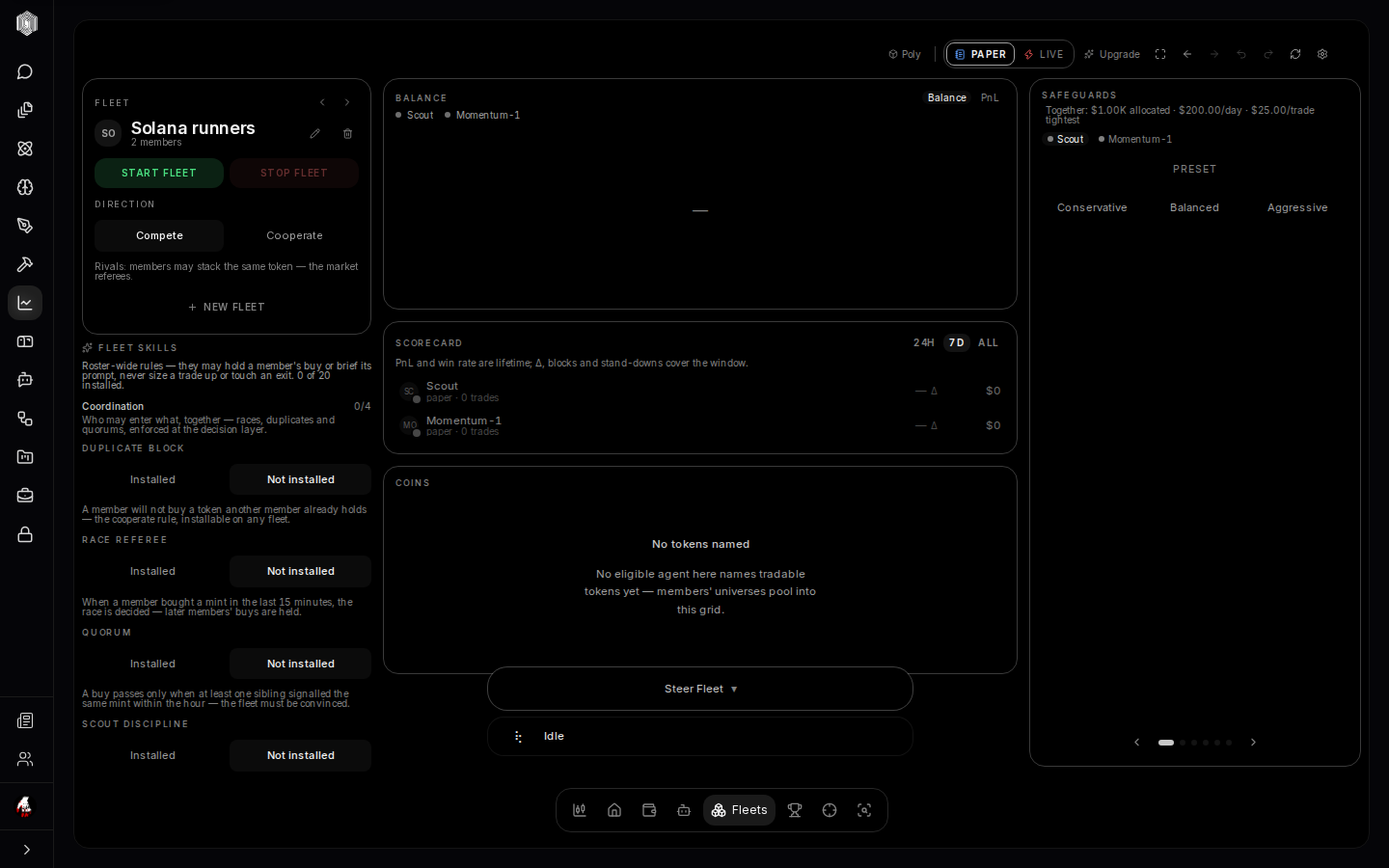
A fleet is a group of your agents running as one crew — or one rivalry. Instead of starting and stopping agents one by one and reading their feeds separately, the fleet console gives the group a single page: one balance chart with a line per member, one combined coin grid, one scorecard, and one place to steer them all. A fleet is also how the interesting behaviors become possible at all — competition, cooperation, scouts feeding discoveries to executors — because those are properties of a group, not of any single agent. You reach it from the Fleets dock icon, or the Fleets door on the Home page's agents card.
Members — who is in
The members card is the fleet's roster. Adding an agent is one click on its row; removing is the button beside it. An agent you exclude (the eye switch) stays on the roster, dimmed, but sits out the fleet's runs — exclusion is "sit this one out," not "you're off the team," and the dimmed row makes that honest. Every member keeps its own universe, its own safeguards, and its own funds; joining a fleet changes how agents are coordinated, not what each one is allowed to do. Excluded members are never counted in the fleet's totals, so the numbers you see are the numbers that will actually run.
Direction — rivals or crew
The fleet's direction is one switch with two words on it, and it decides how members treat each other. In Compete mode, siblings are rivals: each agent reads the others' moves as information in a race — someone got there first, outrun them or fade them. In Cooperate mode, siblings are crew: the same moves read as "this position is taken" — a token a crewmate already holds is not a second entry, and members look for their own trades instead of doubling each other. The direction is not a suggestion; it is written into every member's decision prompt in the same words, so the whole fleet knows which game it is playing. Flip the switch whenever you like — the fleet re-reads it on the next decision.
Fleet skills — rules the whole floor obeys
Below the roster sits a second catalog — fleet skills — twenty rules that act on the group rather than on one agent, arranged in five shelves. Coordination holds duplicate trades: if two members eye the same token at once, a rule can decide who goes and who stands down. Fleet risk caps the whole book: a shared heat limit, a drawdown breaker that pauses entries when the fleet is down, a combined daily budget. Rivalry sharpens compete mode — crediting the first mover, noting the crowd. Discipline catches churn, oversized trades, and loss streaks. Information relays what the roster knows: refusals, winners, stale news. The contract is deliberately one-sided: a fleet skill may hold a buy or add a note — never enlarge a trade, never force one, never touch an exit. Every time a fleet skill blocks something, the block lands in the feed with its name on it, so nothing is ever silently refused.
Scouts — the finders
Any member can be marked as a scout (the radar switch on its row). A scout still trades like any agent — what makes it a scout is what happens when its exploration finds something: the accepted discoveries are automatically offered to the other members' universes, within each one's cap, and never overwriting tokens you named yourself. Held tokens are never pushed, and when a member is full, the overflow is reported rather than dropped. The usual shape is one scout with a wide exploratory universe feeding a few focused executors — the pack hunts together while the scout ranges ahead.
The scorecard — who is carrying the team
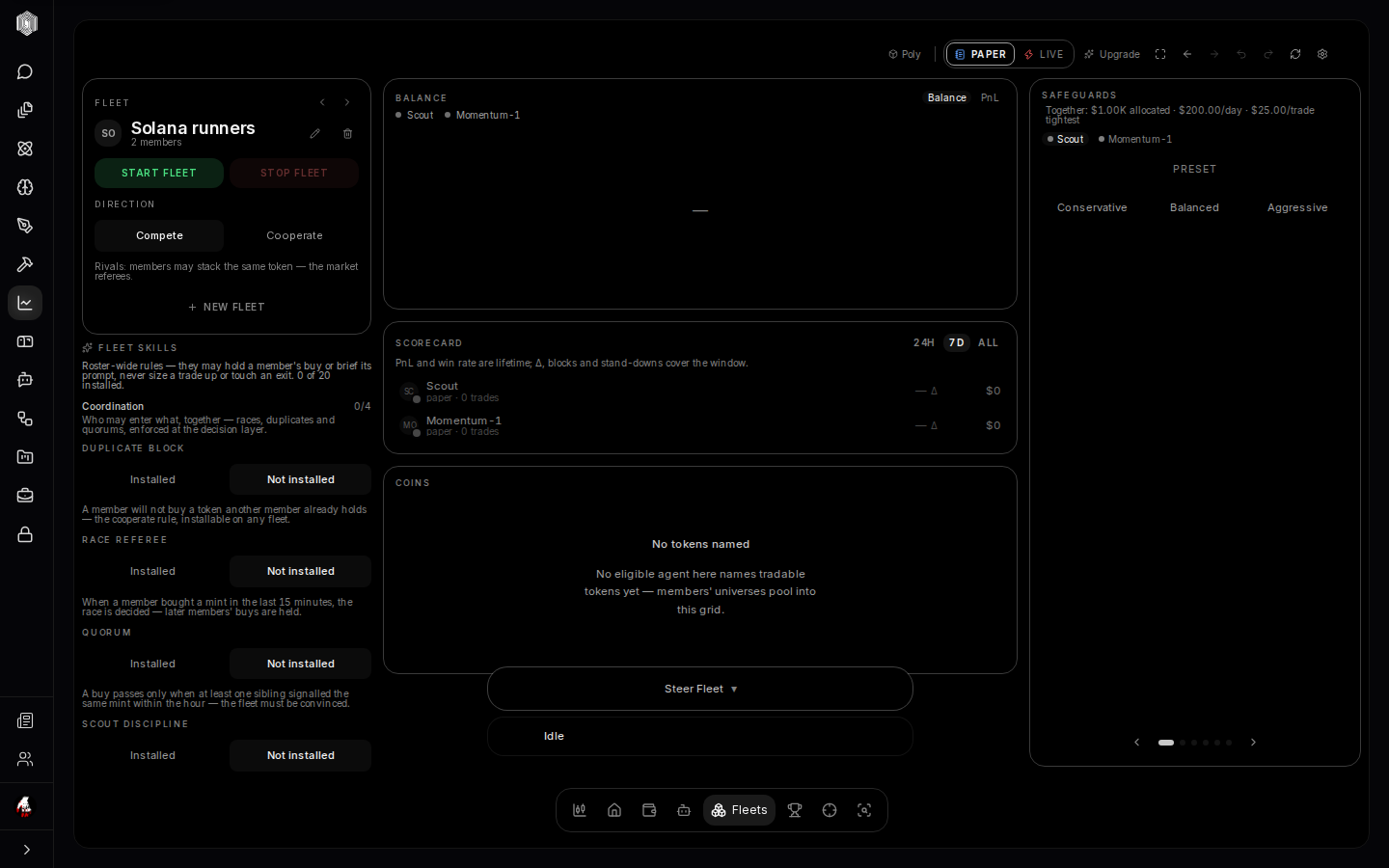
The scorecard is where the fleet gets honest. One row per member: realized PnL, win rate, trades, blocks, stand-downs, share of the fleet's profit, and the change in marked value over the window you pick (24h, 7 days, or all time). The numbers obey one law worth internalizing: a trade that has not decided yet is a blank, never a zero, and a member that did nothing in the window says so instead of dressing up as a zero. A paper member wears its paper chip right in the row. Between this card and the money chart above it — one line per member — the question "who is actually pulling their weight" stops being a feeling and becomes a table.
Safeguards and steering
The right-hand column mounts each member's full safeguards carousel — the same four pages the agent's own page has — switched by a pill per member, so you can tune the whole fleet without leaving the console. And at the bottom edge, Steer Fleet opens a composer addressed to the group: guidance that lands in every member's next decision, worded by the direction you chose. In compete mode your steer reads as race commentary; in cooperate mode, as a note from the crew lead. As with a single agent, steering moves judgment — the safeguards stay exactly where you set them.
Starting and stopping
The fleet card's start button arms every eligible member at once, and stop stands them all down — the same arming path a solo agent follows, alerts and permissions included, so nothing about running as a group lowers the bar a single agent had to clear. The console's feed merges every member's actions into one stream, each sentence attributed to its speaker, so the fleet reads like a room rather than a spreadsheet: who bought, who refused, who was held by a fleet rule, and why. Read the feed for a day and you will know the fleet's personality — which member jumps first, which one waits, which one the rules keep catching — and that knowledge is exactly what the direction switch, the skills, and the steering exist to act on.