Skills, hooks & helpers
Every agent makes its decisions from the same ingredients: the coins in its universe, the market data it can see, the rules you set, and — this page — a set of skills, hooks, and helpers that change what it notices before it decides. These are the difference between two agents built from the same template: one that watches a price and one that watches everything around the price. None of them can make an agent spend more or take bigger risks; that is the one rule of the whole system. They widen what the agent pays attention to. The guardrails still decide what it is allowed to do about it.
The skill library
Open an agent's builder and the Skills & hooks card shows a library of small, focused capabilities arranged on five shelves. Entry filters are quality gates for buys — they check whether a setup is as good as it looks, and refuse to cheer for a token that fails the check. Exit feelers watch held positions and speak up when a trend looks tired, long before any stop-loss fires. Momentum & timing reads the oscillators — the instruments that try to catch a turn as it happens rather than after the news about it. Market structure looks at depth, supply, and who could move the market. Sentiment & flow listens to the tape: whether the trading in a token looks organic or manufactured. Each skill has a plain-language description and installs with one click, and the card keeps count — "installed" is always a fact, never a guess.
A skill is not an order; it is a voice. When a skill has something to say, its note enters the same ranked feed the agent's own strategy reads, and the agent weighs it like any other input — it can agree, or not. What a skill can also carry is a line of vocabulary: a short instruction in the agent's own prompt, so the agent knows why that skill's signal exists and how seriously to take it. That is the quiet difference between an agent that sees a number and an agent that understands what the number means.
Your own hooks
Below the library sits the part you write yourself: hooks — small, declarative rules shaped like "when RSI is above 70 and I am holding, say consider exiting." You pick the conditions from dropdowns (no code), give the rule a strength, and install it on any agent. Because hooks compile into the same shape as library skills, everything downstream is identical: the rule speaks into the feed, the agent weighs it, the guardrails still gate the trade. Hooks import and export as JSON, so a rule you like travels between agents — or between you and a friend — as a file. An agent referencing a hook you deleted does not break; it simply stops hearing the voice.
Strength — how loudly a rule speaks
Both library skills and your hooks carry a strength dial, and it does exactly what the word says. A faint signal is a whisper the agent may rightly ignore in a busy market; a strong one is a shout it must address in its reasoning before it does anything else. Strength is per-rule and per-agent — the same rule can whisper for one agent and insist for another — and it is clamped to a sane range no matter what, so there is no setting that turns a suggestion into an order. Tuning strength is the main way you turn a generic agent into your agent: the same library, weighted the way you weight the world.
Helpers — the sub-agents
Before some decisions, an agent can delegate. The builder's sub-agents controls let an agent consult up to four kinds of helpers within a strict budget per tick: a research pass (a quick, structured read on the focus token), its wired web sources (the news feeds and pages you attach), a paper test-transaction (it fires a tiny pretend buy and watches what happens before committing real — or paper — money), and peer reads of other agents you name, so one agent can see "my sibling already bought this and is up." Every helper returns a short written report, and every report is advice: it rides into the agent's reasoning and the log, but it cannot authorize anything the guardrails would refuse. Failed helpers report their failure honestly — a dead source is never a silent one.
Search sources and MCP
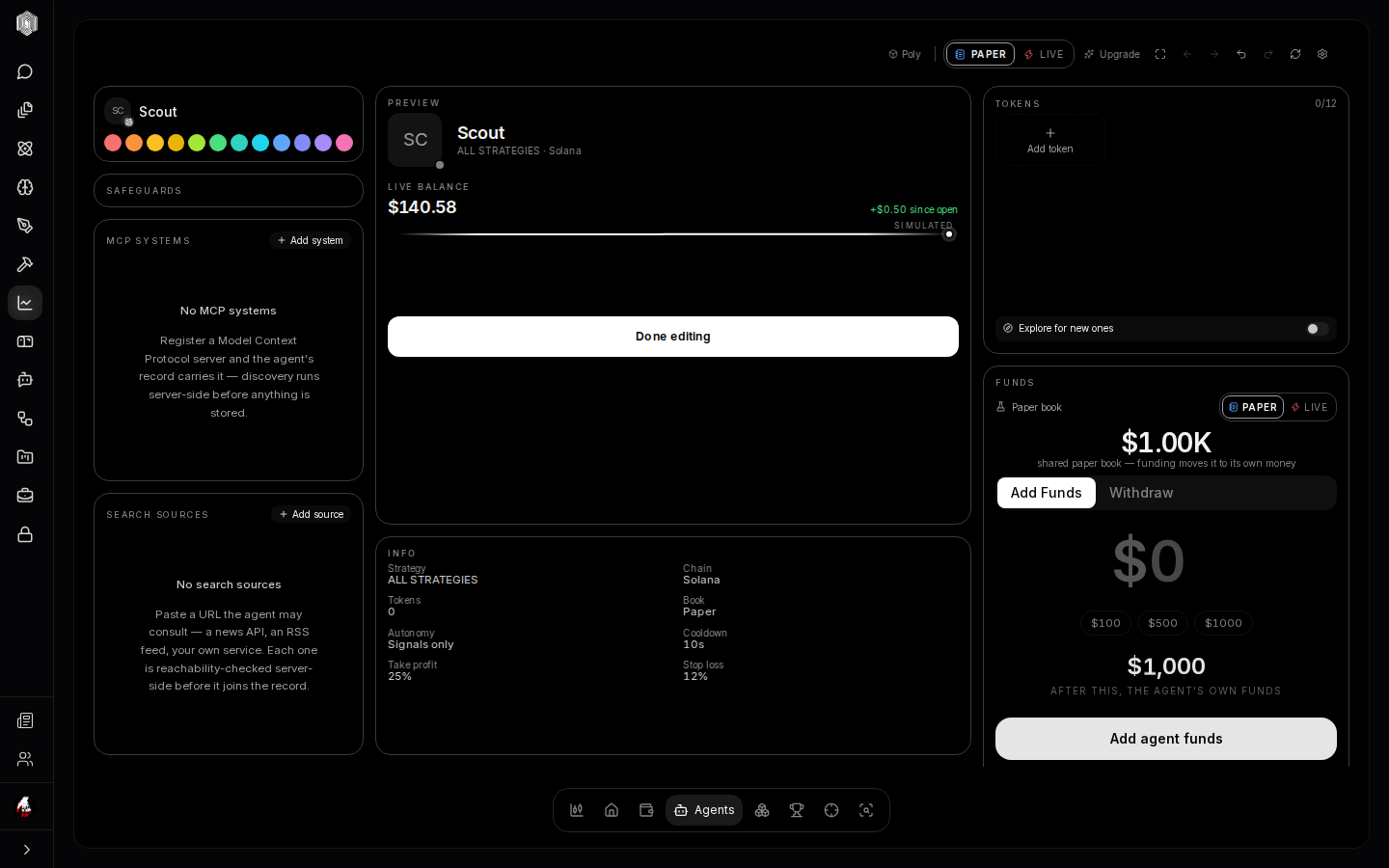
Two cards in the builder round out what the agent knows. Search sources are the feeds and pages the agent may read for news — an RSS feed, a news API, a URL you trust — each verified when you add it, so the agent reads what you chose, not whatever the internet volunteers. MCP systems connect the agent to your own external tool servers, verified before they are added; when a tool is wired, the agent can call it in the course of a tick and record what came back. Both exist for the same reason as everything on this page: to widen what the agent knows, while the safeguards keep deciding what it may do about it.
How far any of this reaches
One boundary worth remembering when you stack all of this together: skills inform, hooks suggest, helpers report — and the safeguards decide. A shout from a strong signal, a peer's winning record, and your own favorite rule, all pointing the same way, still end at the same gate: the per-trade cap, the daily budget, the cooldown, the exits. That is not a limitation someone forgot to remove; it is the property that makes the rest of the page safe to play with. The system is built so that everything you add makes the agent smarter, and nothing you add makes it looser — you can experiment freely with what an agent knows, because what it may spend was settled on a different card.