Tests & games
The measuring instruments — with the section's honesty built into every one. Tests are self-report questionnaires based on published instruments, the Big Five personality inventory, and domain assessments that feed the map. Games measure the other way — cognitive challenges and introspective exercises that score as you play, so a working-memory score comes from actually holding patterns in working memory. Both are labelled self-report/self-reflection tools, never diagnoses.
The tests
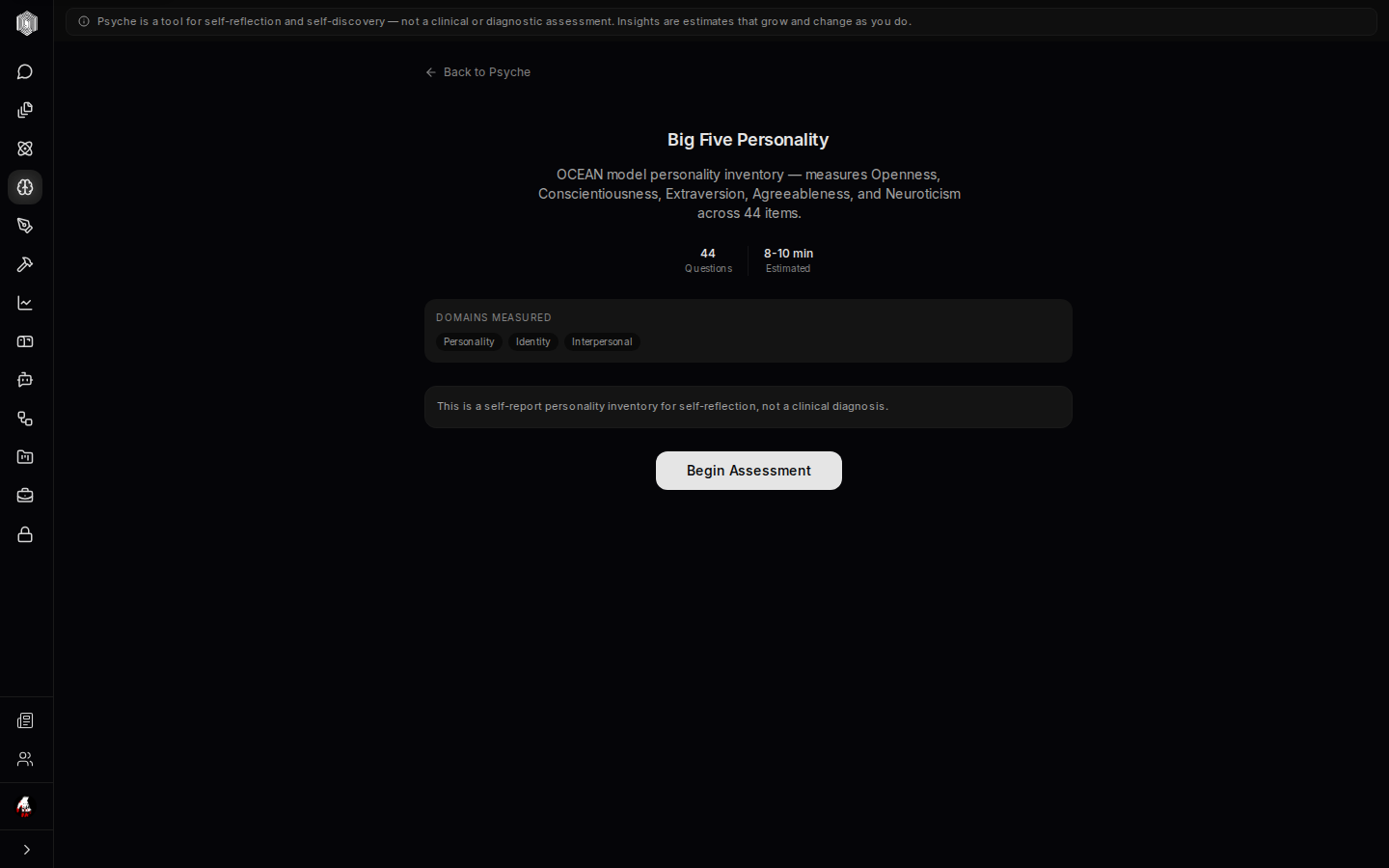
Thirteen tests, in three families. The questionnaires are self-report questionnaires based on published instruments; their scores are not a diagnosis: PHQ-9 for depressive symptoms over the past two weeks, GAD-7 for anxiety, DASS-21 for mood and tension, PSS-10 for perceived stress, PCL-5 for reactions to a stressful experience, ACE for adverse childhood experiences, AUDIT for drinking, the Rosenberg self-esteem scale, and the UCLA Loneliness Scale. The ones with crisis-detection built in — PHQ-9, DASS-21, PCL-5 — watch for answers that indicate risk and respond with the crisis resources, not a score.
The personality family is anchored by the Big Five — the 44-item OCEAN inventory measuring Openness, Conscientiousness, Extraversion, Agreeableness, and Neuroticism — presented with its own line: a self-report personality inventory for self-reflection, not a clinical diagnosis. The domain family feeds the map directly: a Quick Screening of twelve random domains, a Comprehensive Assessment across all twenty-four, and Domain Focus deep-dives into one to five domains of your choosing — from two minutes to a quarter hour.
Every test shows its length and time estimate before you begin, and results land in the map with their confidence attached (page two). A questionnaire score is a snapshot for reflection and a conversation-starter for a professional — the surfaces say this where it matters, and the crisis resources are always one click away.
The games
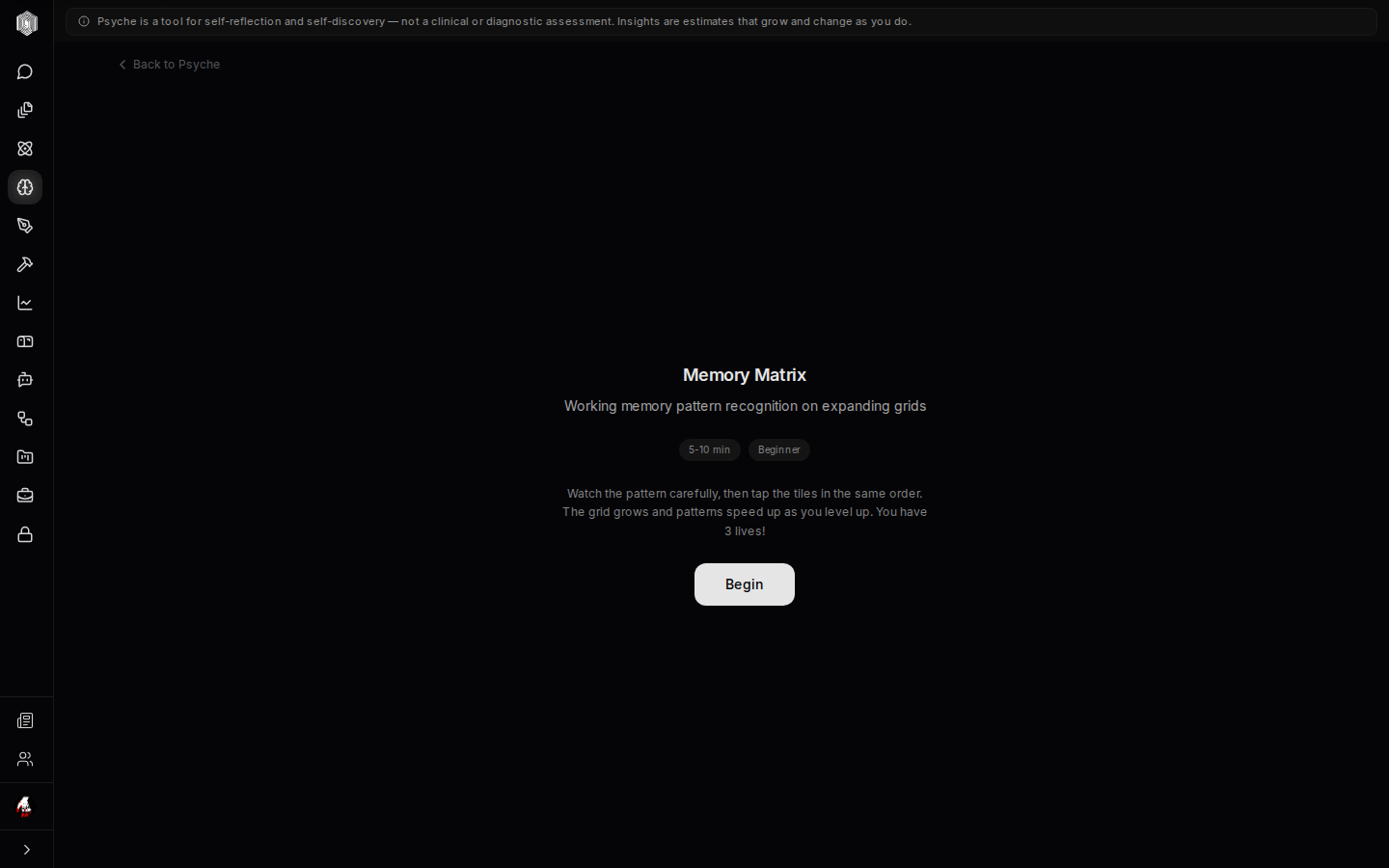
The games measure by playing. The cognitive family runs the classic paradigms of attention and executive function as genuinely playable challenges: Memory Matrix (hold and reproduce expanding patterns), Digit Span (digits forward, backward, and sorted), Stroop Surge (colour-word interference), Flanker Focus (distractor resistance), Impulse Gate (go/no-go response inhibition), Cognitive Switch (rapid task-switching), Speed Scan (processing speed), Vigil (sustained attention through monotony), Signal & Noise (divided attention), and Bias Lens (cognitive blind spots — learn to spot them, then prove you can override them).
The introspective family scores interpretation rather than reaction: Rorschach (inkblot interpretation), Word Shadow (Jungian free association), Emotion Matcher (reading expressions), Emotional Landscape (mapping your affect patterns) — and the rail holds more still, from Mind's Eye to Risk Radar to Values Card Sort, thirty-one games in all. Each shows its duration and difficulty before you begin, and each scores the domains it measures as you play — the map fills while you are having fun.
Scores, honestly
Test and game results feed the same map as everything else, which means the same rules: scores are estimates, confidence is shown, and nothing is a diagnosis. A high working-memory score is a good afternoon at a game; a PHQ-9 result that suggests distress is a reason to talk to a professional, and the surface will say so with the crisis resources in view rather than burying it. The benchmarks lens puts your results in the context of the community distribution — a range, never a rank.
If you only do one thing in Psyche, the tests and games are the highest-signal starting point: ten minutes of play forms real domains, and the instruments are the real thing — presented with the respect of their own limitations.