Readings — 34 traditions
Readings are Psyche's reflective side: thirty-four symbolic traditions, from Tarot and astrology to the I Ching, runes, Jungian archetypes, and Human Design, each offering a structured reading generated by an AI model and framed — relentlessly — as an invitation to reflect rather than a prediction. This page covers how a reading works, the multi-tradition forms, and the guarantees about what the AI is doing.
What a reading is
A reading begins with your intention — the question or focus you bring. Every reading asks for it before anything else, offers starter phrasings when you are stuck ("The guidance I need is about…", "What's blocking me is…"), and lets you skip entirely. Then the tradition's mechanic runs — cards are drawn, hexagrams cast, numbers computed from your birth data — and the AI model writes the reading: what the draw says, how it relates to your intention, and the questions worth sitting with.
The disclosure is printed on the session itself: the content of this reading will be generated by an AI model. The reading is an invitation to reflect and explore — not a measurement of you. Every reading also carries the section-wide line: readings are prompts for reflection and self-exploration — not fact, prediction, or clinical assessment. These sentences are not disclaimers bolted on; they are the product's honest description of itself.
The thirty-four traditions
The catalog spans an unusual range. The classics: Tarot, Astrology, Numerology, I Ching, Runes, Lenormand, Palmistry, Tea Leaf, Dream Analysis, and Bibliomancy. The energetic and somatic: Chakra, Aura, Crystal, Biorhythms, and Ayurvedic Dosha. The psychological: Jungian Archetypes, Freudian Analysis, Cognitive Functions, and Enneagram. The cultural and traditional: Human Design, Kabbalah, Mayan Tzolkin, Ogham, Sacred Geometry, Geomancy, Bone Throwing, the Buddhist Path, Ancient Egyptian, and Sufi Mystic — plus Spirit Animal, Angel Numbers, Past Life, and Akashic Records. Thirty-four in all, each rendered with its own mechanics, not a reskinned template.
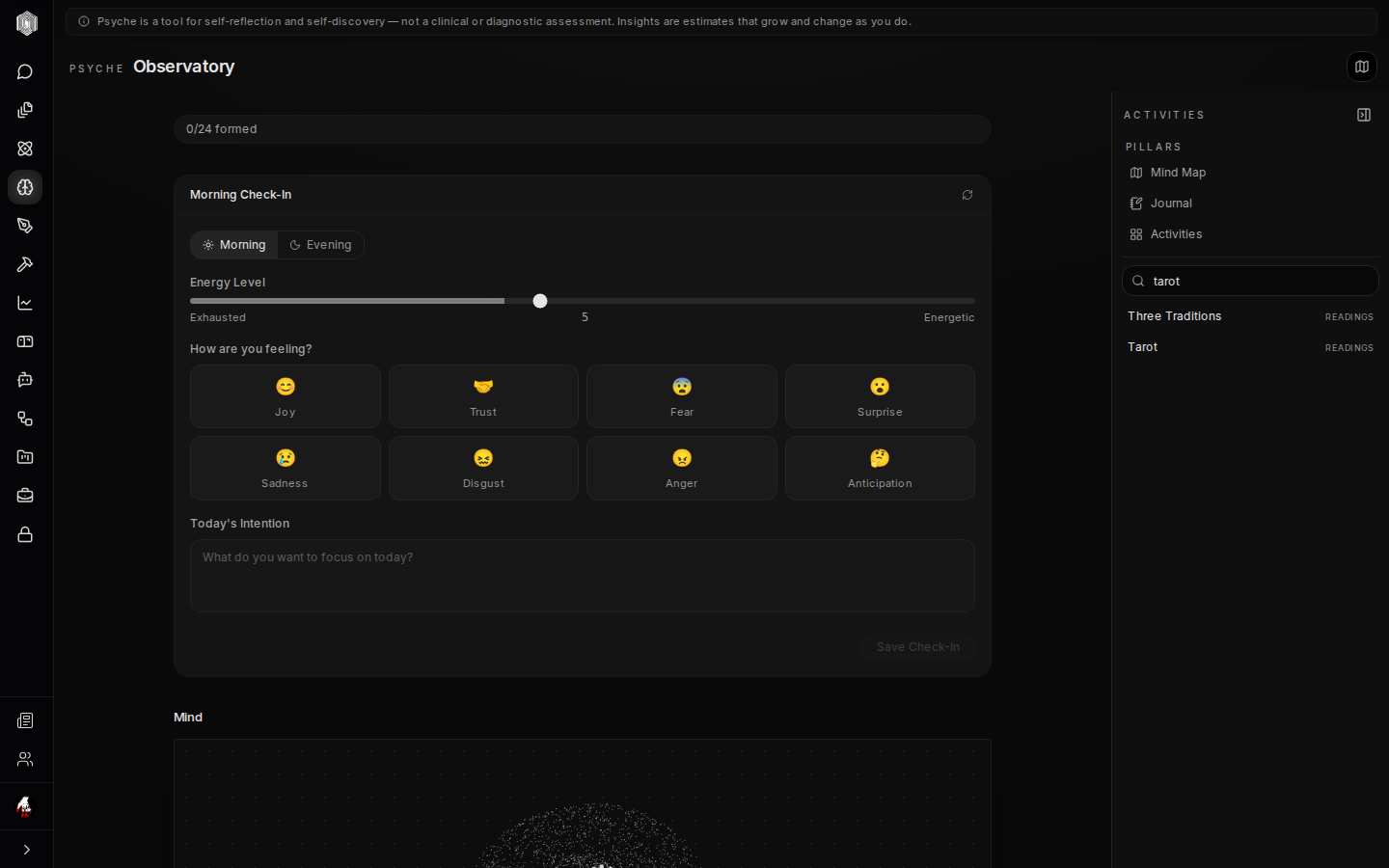
The catalog lives in the home's Activities rail, searchable by name — type "tarot" and the rail filters to it. Completed readings are kept in your reading journal (page five of this group covers the journal and its privacy), and each reading's "how this reading was made" page documents the methodology: what the tradition actually is, how the draw works, and where the AI model enters.
Fusion and the triad
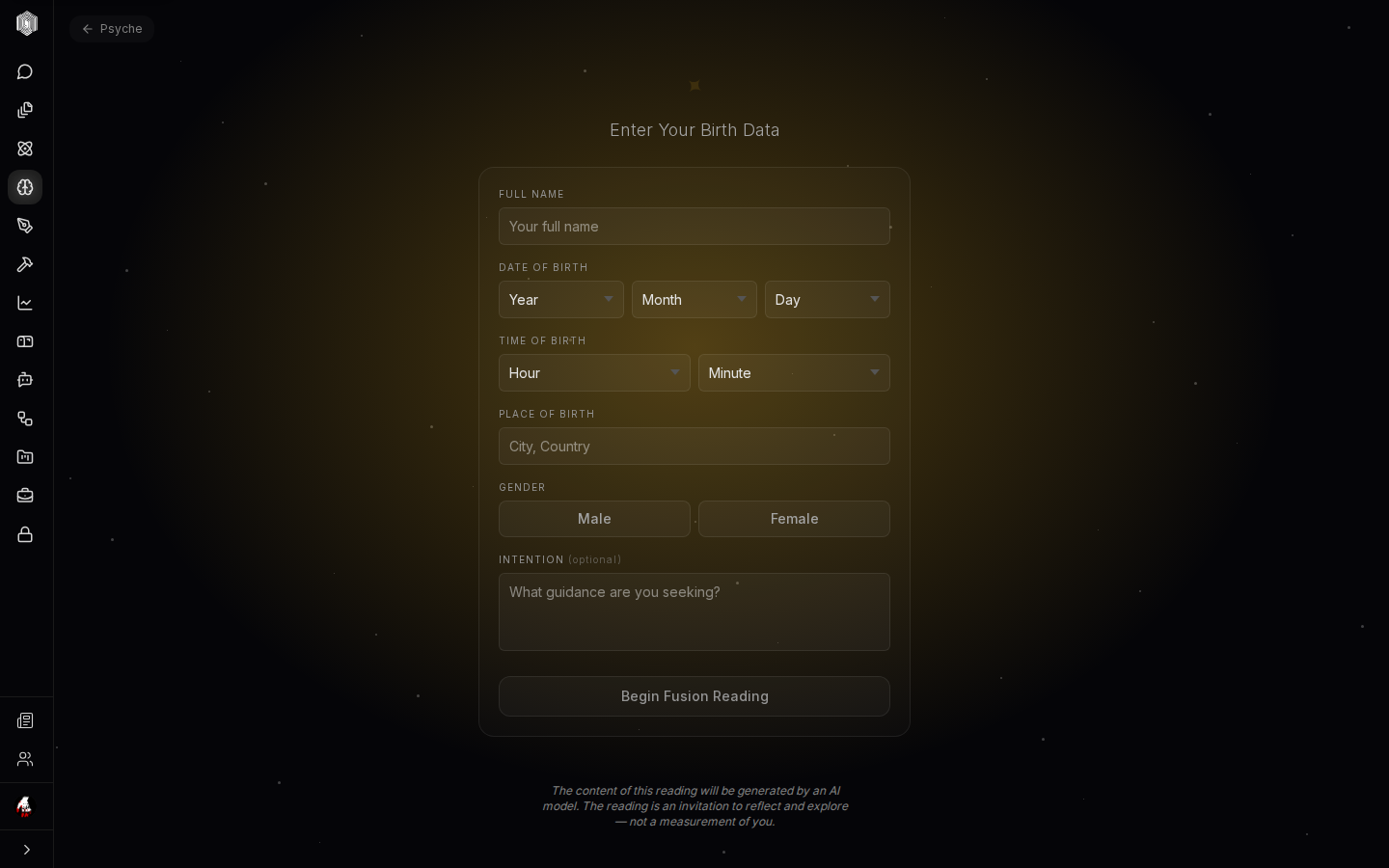
Two forms read more than one tradition at once. Fusion takes your birth data once — name, date, time, place — and weaves several birth-chart traditions into a single integrated reading, with an optional intention. The triad is the sharper instrument: one question, three independent draws — runes, tarot, and the I Ching — where each tradition casts alone, seeing nothing of the others. The value is in the juxtaposition: where all three lean the same way, the reflection has weight; where they diverge, the divergence is the insight.
Both are honest about their machinery. Fusion shows the birth-data form and says the reading is generated; the triad labels itself a juxtaposition of three surfaces, each with its own provenance — which tradition said what is always traceable on the result.
Sharing and the journal
A reading can be shared — a public, view-only snapshot for the person you want to show, revocable like any share — and it can be journalled: your own reflection on the reading, kept in the reading journal beside it. The journal is where readings compound; a year of them, reflected on, is a record of how your questions changed. And everything — the reading, the journal entry, the intention you typed — lives under the privacy rules on page five: kept on your device, with synced copies encrypted with a key derived from a secret our servers hold for your account, so the synced copies are unreadable without that secret, but not to Poly itself; never sold; never asserted as truth about you. To write a reading, your intention and question are sent through our servers to our model provider, and the conversation that produced the reading is kept in your account's chat history.
Readings reward a light touch. One tradition, one honest question, and the willingness to treat the answer as a mirror: that is the whole practice, and the desk is built so that doing it casually still does it right.