Therapy, practices & your data
The reflective side of Psyche, and the ledger behind it. The Therapy tab offers guided reflective conversations with AI personas in the traditions of real practitioners — not therapy, not a diagnosis, and not a substitute for a professional — with a crisis plan written in your own words. Practices are the self-guided tools and exercises drawn from established modalities, launchable without any session at all. And the data ledger is the plain-language record of what Psyche keeps and what it encrypts, each statement paired with the module that makes it true.
Therapy
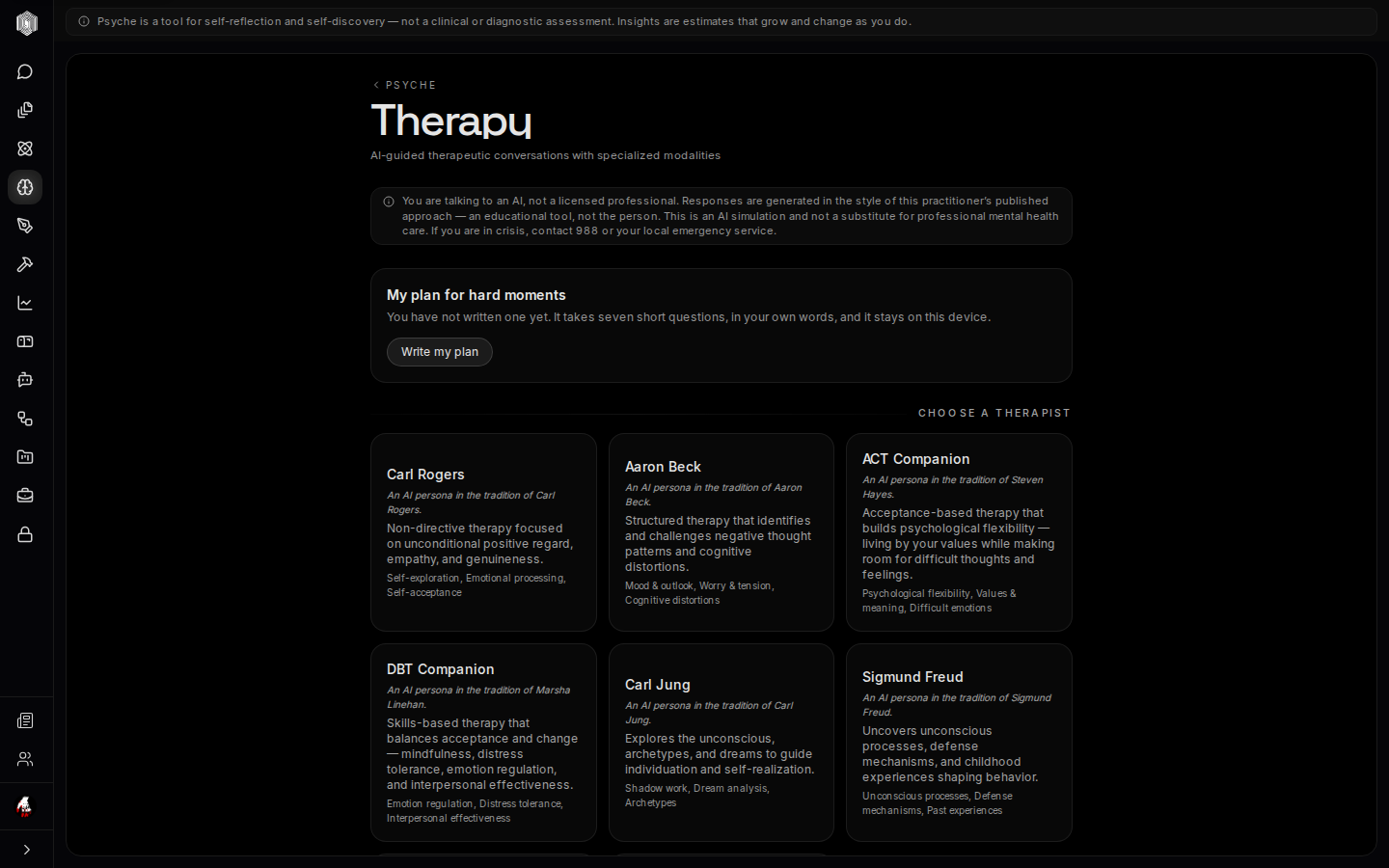
The Therapy tab offers reflective conversations with AI personas, one per modality. The roster spans the major traditions, each persona honest about what it is — an AI persona in the tradition of… — with its approach and its best-fit concerns on the card: Carl Rogers (person-centred: unconditional positive regard, empathy, genuineness), Aaron Beck (CBT: identifying and challenging thought patterns), the ACT Companion (acceptance and commitment — psychological flexibility by values), the DBT Companion (skills for distress tolerance, emotion regulation, interpersonal effectiveness), Carl Jung (archetypes, dreams, individuation), and Sigmund Freud (unconscious processes, defence mechanisms, childhood).
The disclosure at the top of the hub is the contract, printed in full: you are talking to an AI, not a licensed professional; responses are generated in the style of the practitioner's published approach; it is an educational tool, not the person, and not a substitute for professional mental health care — and if you are in crisis, contact 988 or your local emergency service. Sessions are kept in a therapy history you can revisit; they are logged, but the conversation itself does not move a domain score; a session's mood check-in (when your mood rises) and exercises or tools you complete do. Each message is sent through our servers to our model provider to write the reply (or to the local model you chose).
My plan for hard moments
Above the persona cards sits the surface's quiet centrepiece: My plan for hard moments. It takes seven short questions, answered in your own words, and produces a crisis plan — what your warning signs look like, what helps, who to reach, and what to avoid — that stays on this device. Writing one while you are steady is the whole trick; the plan exists so the hardest moment has fewer decisions in it. You can revise it whenever your answers change, and because it lives locally it reads the same with or without a connection.
The plan pairs with the crisis resources — 988 (Suicide & Crisis Lifeline, call or text) and the Crisis Text Line (text HOME to 741741) — which are surfaced on the practices page and inside the self-report questionnaires. The design rule is stated in the code and honoured on screen: non-alarming, always available, never in the way — resources that assume an adult reading them, not an alarm assuming the worst.
Practices
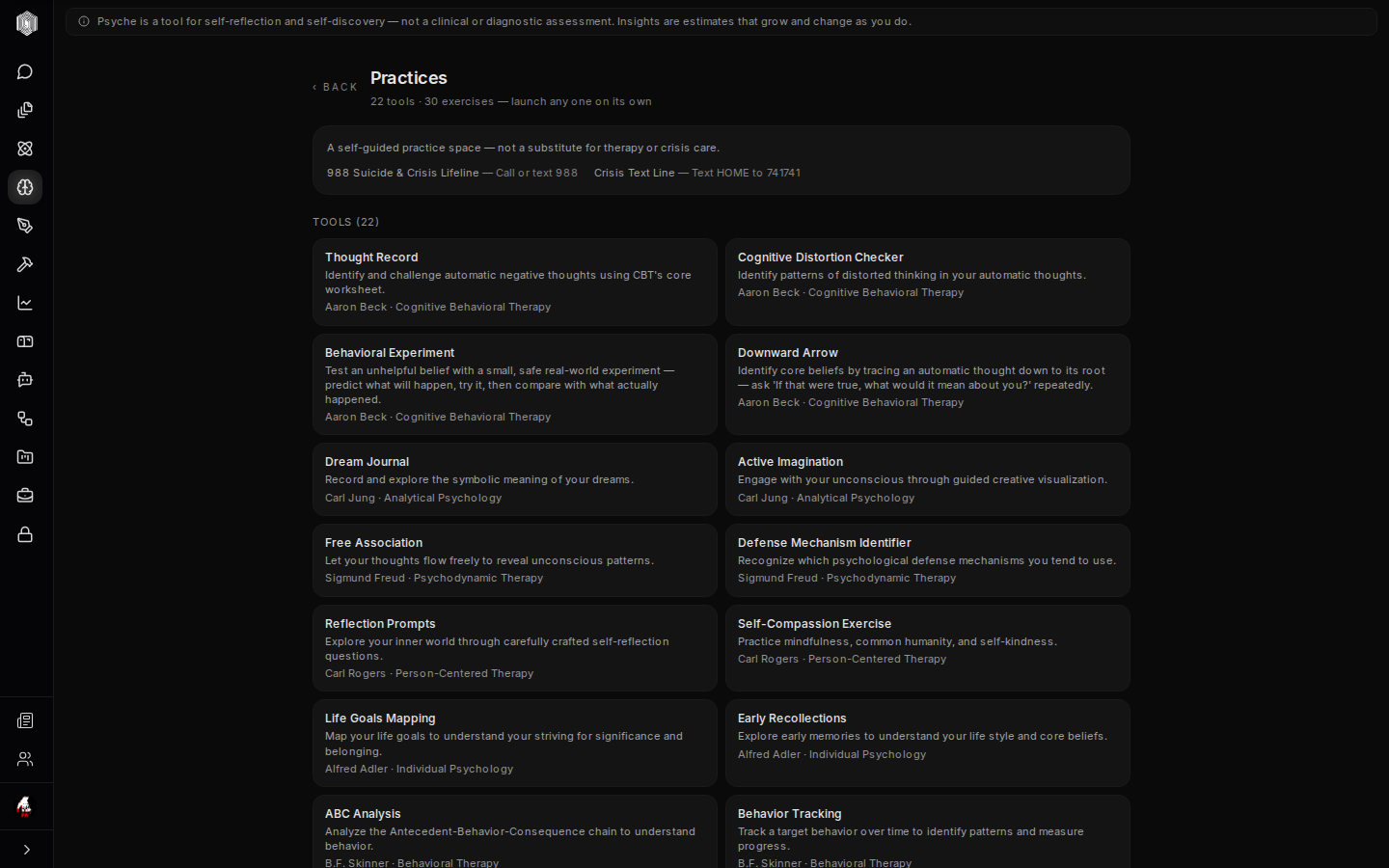
The practices catalog is the self-guided floor: 22 tools and 30 exercises, each launchable on its own, each attributed to the tradition that built it. The CBT set runs from Thought Record and Cognitive Distortion Checker to Downward Arrow and Behavioral Experiment. The Jungian set has Dream Journal and Active Imagination; the Freudian, Free Association and Defence Mechanism Identifier. Rogers contributes Reflection Prompts and Self-Compassion; Adler the Life Goals Mapping and Early Recollections; Skinner the ABC Analysis and Behavior Tracking. Grouped by skill — breathing, grounding, relaxation, DBT skills, behavioural activation — each practice launches standalone, scores what it measures, and completes in minutes.
Your data: the ledger
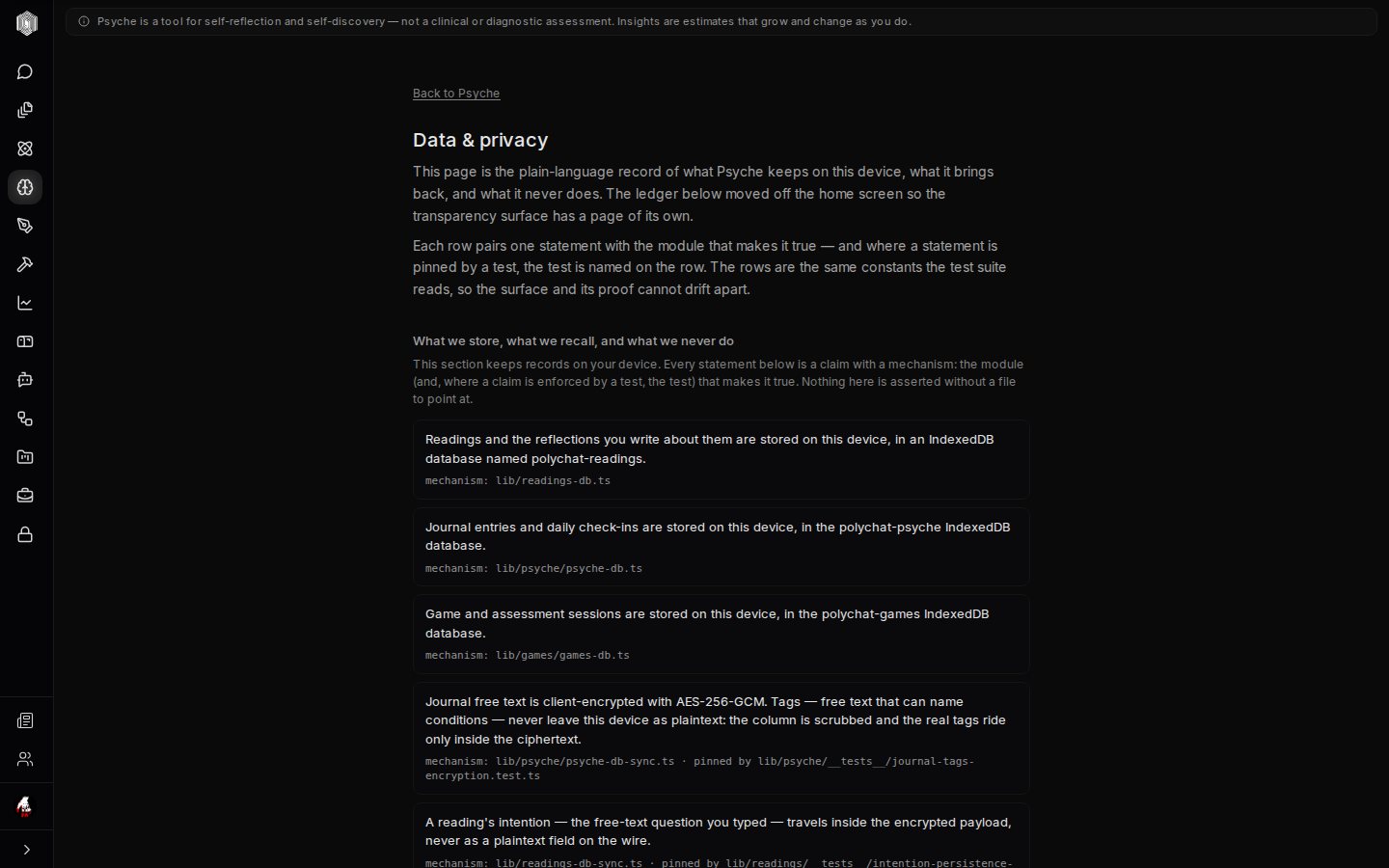
Psyche's privacy page is a ledger, and its design rule is unusual: each row pairs one statement with the module that makes it true — and where a test enforces the claim, the test is named on the row, so the surface and its proof cannot drift apart. The claims are concrete: reflections live on this device in an IndexedDB database; readings are produced by our servers and the conversation that produced each one is kept in your account's chat history; journal entries and daily check-ins live on this device too; game and assessment sessions likewise. Journal free text is encrypted in your browser with AES-256-GCM before it syncs, with a key derived from a secret our servers hold for your account, so the synced copies are unreadable without that secret, but not to Poly itself. Tags — free text that can name conditions — now sync only inside that ciphertext; mood ratings sync as plain values. A reading's intention syncs only inside the encrypted payload. To write the reading it is sent, through our servers, to our model provider, and the conversation that produced the reading — your question included — is kept in your account's chat history.
The page is also where your data rights live in practice: what syncs after you turn sync on, and which parts of it are encrypted, what stays on this device unless you use an AI feature, and how to clear Psyche's data entirely. Each row names the module that makes it true, so you can check it.