Psyche — start here
Psyche is the self-reflection desk. It gathers readings, psychological tests, cognitive games, journaling, and guided reflective conversations with AI personas into one place, and — the part that makes it different — it turns everything you do there into a personal map across twenty-four domains of character. This page is the orientation: what Psyche is for, the honesty rules it never shuts up about, and how the pieces fit. The four pages after this one go room by room.
What Psyche is — and is not
Psyche is a tool for self-reflection and self-discovery. Every surface repeats it, and the repetition is the design: insights are estimates that grow and change as you do — not clinical or diagnostic assessment. Readings say it in their own words: they are prompts for reflection and self-exploration, not fact or prediction. Tests describe themselves as self-report inventories. The therapy surface says plainly that you are talking to an AI in the style of a practitioner's published work, not to a person, and never a substitute for professional care.
This is not boilerplate; it is the contract. Everything Psyche shows you is a mirror with estimates on it — useful for noticing patterns, asking better questions, and watching yourself change over time. If any surface ever feels like more than that, the crisis resources (page five) are one click away everywhere.
The home: observatory, check-ins, activities
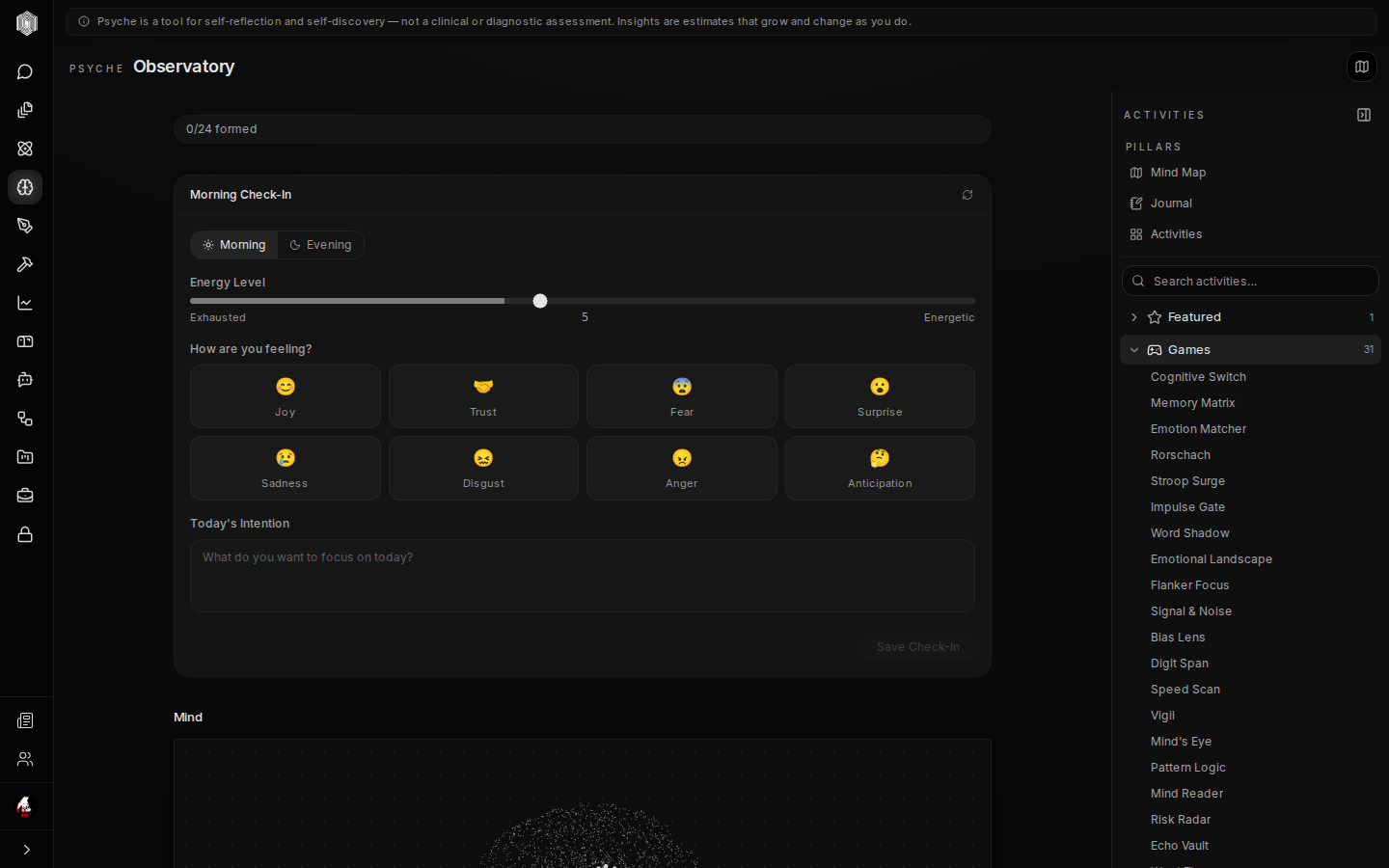
The home is built around a daily rhythm. The Morning Check-In (and its evening twin) asks your energy level, how you are feeling, and your intention for the day — thirty honest seconds. Below it sits the Mind section: your brain map, which is where everything you do lands. The right rail is the activities index: Featured, Games (31), Readings (34), Tests (13), Practices (52), and Therapy (10), each searchable by name.
The three pillars organize it: Mind Map for the full observatory, Journal for writing and reflections, Activities for the full catalog. Whatever you complete — a check-in, a game, a test — feeds the map, which is the next stop on this tour. Readings and Therapy-tab conversations are logged, but the conversation itself does not move a domain score; a session's mood check-in (when your mood rises) and exercises or tools you complete do.
The map your activity builds
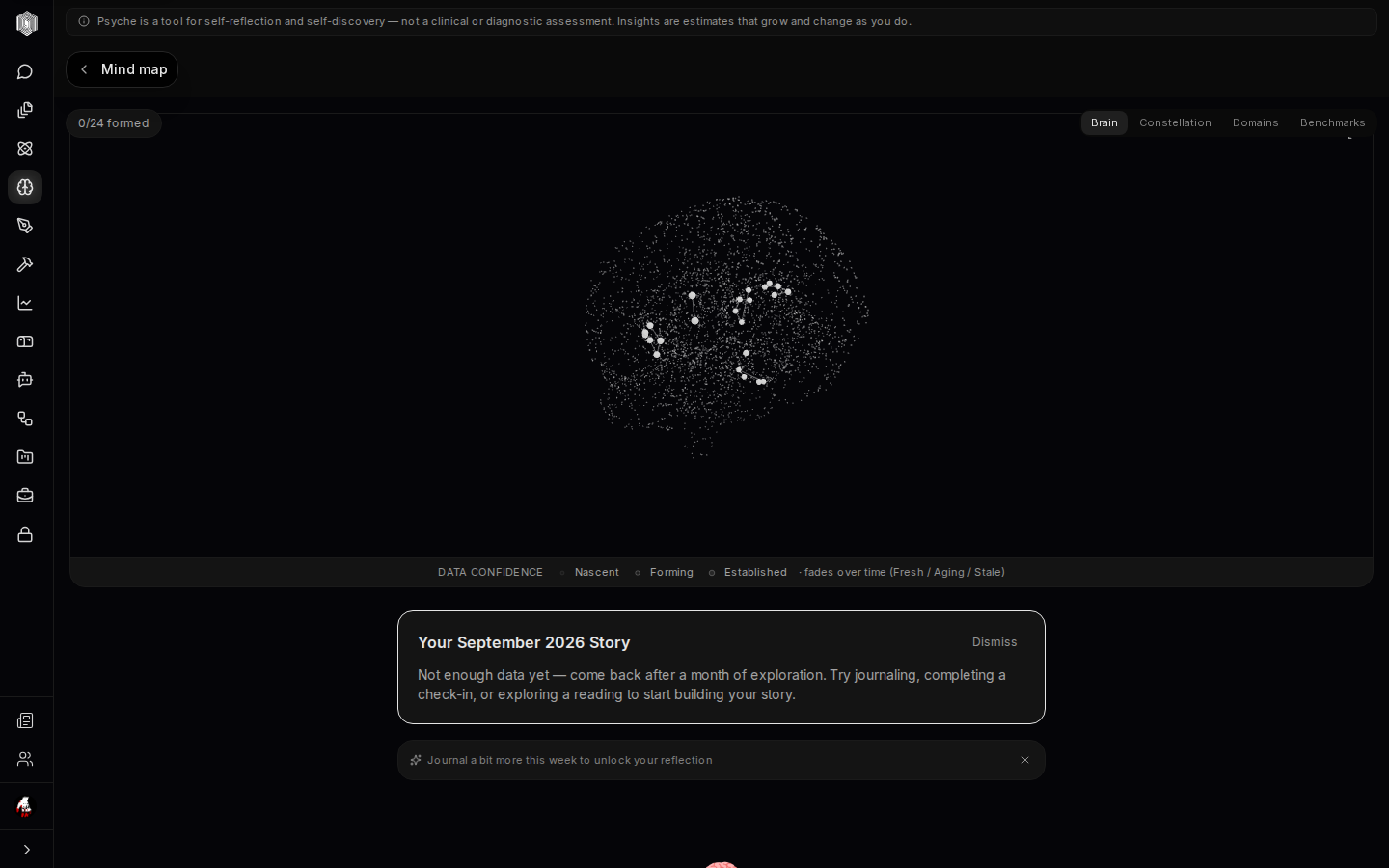
Every activity scores a set of domains — Personality, Emotionality, Attachment, Cognition, Resilience, and twenty more — and the map is those domains drawn as a brain. A new account starts at 0/24 formed, and the map says so plainly: domains form as evidence accumulates, and the data-confidence legend (Nascent, Forming, Established) shows which estimates to trust. Nothing is asserted from one data point; the map's honesty is the point.
The map has four lenses — Brain, Constellation, Domains, and Benchmarks — each a different reading of the same data (page two). The profile page adds the counters: how many readings, tests, games, Therapy-tab conversations and journal entries you have, your day streak, and all twenty-four domains ranked, with faded bars for the ones not yet touched enough to trust.
The rooms
Readings (34 of them) span Tarot to Human Design — intention-first reflections generated by an AI model, with fusion and three-tradition casts when you want more than one lens. Tests are real instruments: PHQ-9 and GAD-7 for mood and anxiety, the Big Five personality inventory, and domain assessments from two minutes to a quarter hour. Games are cognitive and introspective — working memory, attention, impulse control, emotional recognition — that score as you play. Therapy offers AI personas in the traditions of Rogers, Beck, Jung, Freud, and others, plus practices and a crisis plan. The Library of it all — the journal and the data ledger — closes the loop.
Each room has its own page in this guide, with its own screenshots and its own copy of the honesty rules. The constant: Psyche measures nothing about you that you did not put into it, keeps that data close (page five covers exactly where), and shows you the estimates as estimates.
Getting started
The shortest useful session: do the check-in, play one game, and read one reading — then open the map and watch three domains begin to form. The check-in takes under a minute; the games list every game's length before you commit; a reading is as long as the intention you bring to it. None of it requires preparation, and nothing is graded.
Come back tomorrow — that is the whole practice. The streak counter and the map's data confidence both reward returning: a second check-in makes the first one mean something, and a week of small entries forms domains that a single long session cannot. The practices and the Therapy tab are there whenever you want them, with no prerequisites and no completion meter; the desk is built for returning to, not finishing. And if any surface ever raises something that feels bigger than self-reflection, the crisis resources are one click away on every page, with 988 and the Crisis Text Line at the top.